
BLOGS (STILL RANDOM)
Blogs (Still Random) is exactly what it sounds like — a fairly random, blog-like space where Terry and I reflect on what we’re hearing, thinking and sometimes still puzzling over after our This Way Up interviews. That’s the plan. What it actually becomes is another matter. Stay with us — we’re very much beginners in the game.
Testing for Truth: Ferial Adams and the Water Revolution (Babette)
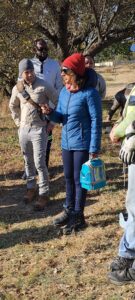 Water is something most of us only think about when it stops coming out of the tap. What struck me most about speaking to Ferial Adams is that she has found a way to turn that frustration into evidence, and evidence into action.
Her water testing kits cost about R200, but what they really provide is something much more valuable: proof. Communities that have spent years being told their water is fine can suddenly demonstrate that it contains E. coli. People who have been dismissed as complainers can point to evidence and say, “No, this is real.” Listening to Ferial describe activist citizen science made me realise that knowledge is not just power. Sometimes it is dignity.
The story that stayed with me was a community in KwaZulu-Natal that had gone three years without piped water. After testing revealed contamination, water tanks arrived within days and piped water followed soon after. It was a reminder that change is often less about finding solutions than forcing people to acknowledge a problem they would rather ignore.
Perhaps what I found most inspiring was Ferial’s vision of a thousand ordinary citizens across South Africa regularly testing water and holding municipalities accountable. Not waiting for someone else to fix things. Not assuming somebody else is in charge. Just people, armed with information, refusing to look away.
After all, if safe water is a basic human right, why should proving that it isn’t safe fall to the people who are already suffering from it?
The River Runs Through Us (Babette)
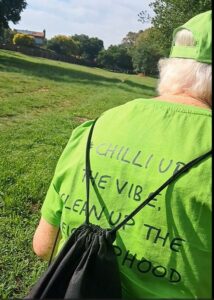 Chantal Nativel talks about the Braamfontein Spruit the way some people talk about a family member. Not as an abstract environmental issue, but as something living that she knows intimately and feels responsible for. She works at the confluence of the Braamfontein Spruit and the Jukskei River, a meeting point that feels symbolic of the larger environmental pressures facing Johannesburg itself.
Listening to Chantal made me realise how much labour sits behind places that still feel natural. Clean water, clear pathways, birds returning, fewer plastic bags caught in reeds. None of that happens accidentally. Someone notices. Someone keeps coming back. Someone cares enough not to give up.
What struck me most was the scale of persistence involved. Cleaning a river in Johannesburg is not a task you finish. The rubbish returns. Illegal dumping returns. Pollution returns. And still she and her volunteer helpers go back.
There was something moving in the way she spoke about the river not only as an environmental resource, but as a shared public space that affects dignity, safety and community. Many of us assume environmental work is driven by grand gestures or large organisations, but Chantal reminded me that a huge amount of change begins with people quietly refusing to look away from damage that everyone else has normalised.
Our interview left me thinking about how easy it is to mourn the state of things while doing very little. Chantal’s response is the opposite. Perhaps that is the point. The decision to keep showing up for a place you love.
He Had Eight Stars (Babette)
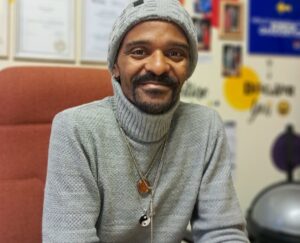 “It’s not just about me. It’s about preventing more copies of the negative me.”
That’s Welcome Witbooi, who runs Brightspark Foundation. I think it might be one of the most devastating and powerful things I’ve ever heard anyone say.
Welcome grew up in Valhalla Park on the Cape Flats, a straight-A student until gang leaders convinced him that education was a white tool meant to control people like him. He joined a gang, was sentenced to 23 years, and served time in Pollsmoor Prison.
I didn’t know much about the Numbers gangs before this conversation, the 26s, 27s and 28s, or that they effectively control parts of South African prisons from the inside. In the 28s, status is marked in stars tattooed on the shoulders, each one earned through the stabbing of a correctional officer. By the time Welcome was 25, he had eight.
A restorative justice programme fundamentally changed things for Welcome. After he got out, he went to find the family of a man he had killed and asked for forgiveness. That idea of repair now sits at the heart of Brightspark, reaching out to support young people the system has already written off.
Sitting across from him, it was hard to reconcile the warm, funny, grounded man in front of me with the life he described. But that gap is the point. He is both, and what happened in between is something I won’t forget.
The Simplest Climate Solution We’re Ignoring (Babette)
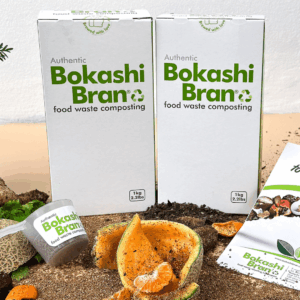
Composting food waste is something I’ve always done. It’s just been part of how I live. But Bokashi bran is something else entirely. What it does feels almost like magic, which makes Bronwyn Jones seem less like an environmentalist and more like an alchemist.
What struck me just as much was how quietly embedded this already is. This isn’t a pilot or a moonshot. It’s running in homes and commercial kitchens right now, doing its work in the most unremarkable corners of ordinary life.
We’ve had many memorable interviews, each for its own reason, but this one stayed with me. Maybe because the gap between the problem and the solution felt so absurdly small. A bucket. A sprinkle. An almost 98 percent reduction in emissions. So honestly — what’s stopping us?
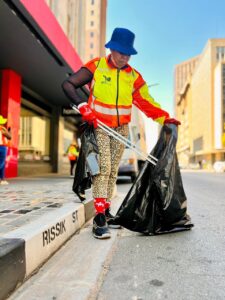 Unseen, but Essential (Babette)
When I first came to South Africa, waste pickers were just part of the background at traffic lights and on pavements. I didn’t really see them. Meeting Sifiso Gumbi changed that. What I had taken for disorder is actually a system that is organised, consistent and essential to the city’s functioning.
Waste pickers are often seen as a problem to be removed. But what struck me most from what Sifiso shared is how easily they could be supported and integrated through relatively simple changes: space to sort, somewhere to store, somewhere to stay, and basic recognition.
Hearing how the waste pickers of Urban Surfers organise themselves, showing up every day with no safety net and just effort.
There is a whole community out there doing essential work, but that is still largely unseen. It feels important to tell that story properly. because once you’ve seen it, you can’t really unsee it.